A seed amnesty and register
Let growing families register their landrace safely, with no risk of prosecution for doing so.
Mpondo Gold, Durban Poison and the plant behind them: what we know, what we do not, and what we ask for.
South Africa's landrace cannabis, the plant behind Mpondo Gold and Durban Poison, is its oldest cannabis genetics. No one can say how much is grown, no one has fully mapped or protected it, and no one has traced where its value went.
Landrace cannabis is the unselected, locally adapted plant that farming families have grown and saved for generations. It is potentially the foundation of any fair South African cannabis industry, and the part of it with the least protection. This page sets out what we know, what we do not, and what we ask for.
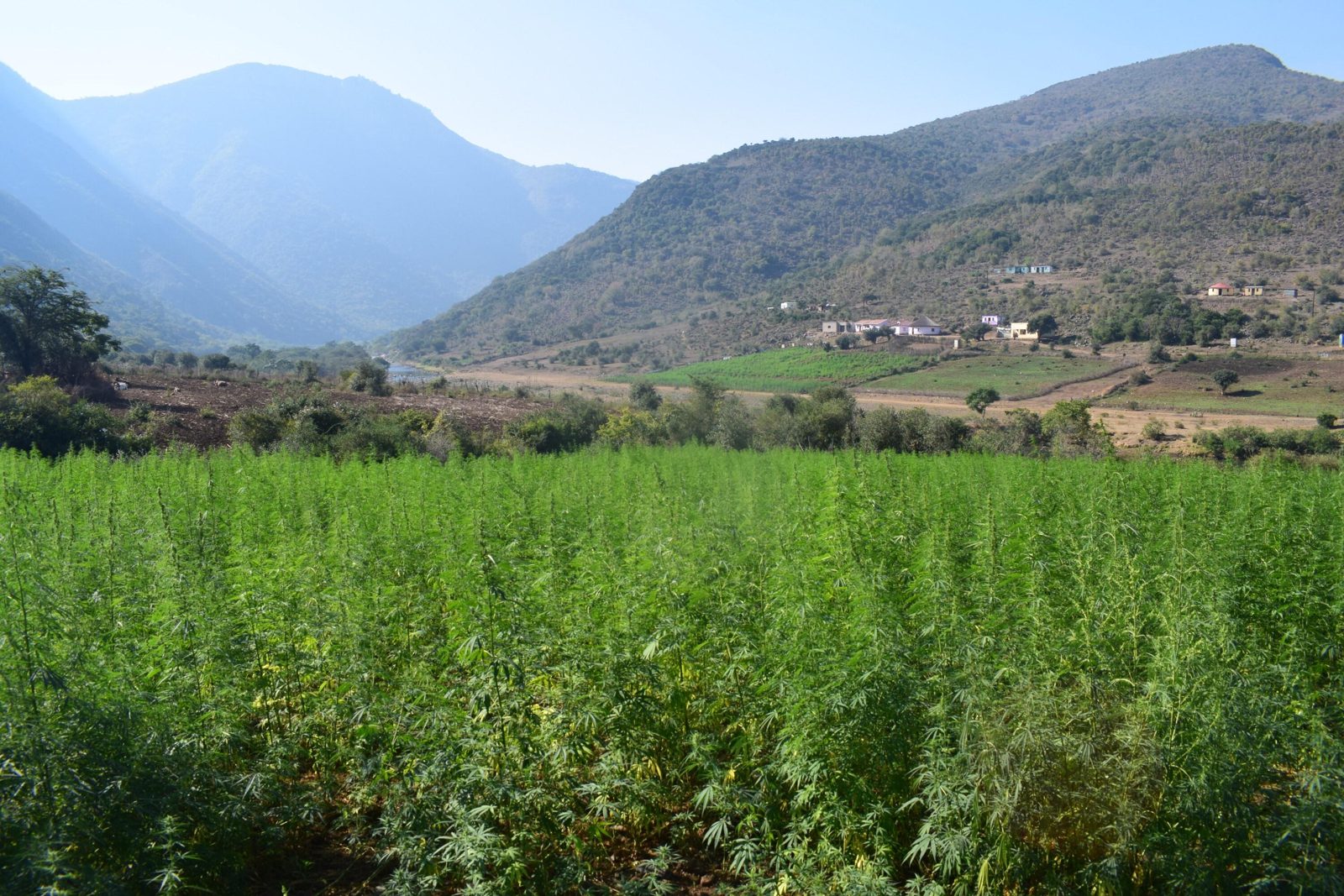
hectares of landrace in Mpondoland alone (Grooten, 2023). The whole EU grew 37,830 hectares of hemp in 2025 (Eurostat)
farming households grow landrace cannabis in Mpondoland alone (Grooten, 2023)
THC in the Mpondoland landrace, all above the 2% hemp ceiling, so shut out of the legal crop
Sit through any cannabis forum in South Africa and the same stories come up. Families fed through hard years. Children kept in school. A son or daughter sent to university on a crop grown at a homestead on a hillside.
The research bears them out. In Mpondoland, cannabis money built most of the traditional homesteads, let young people finish primary school and in some cases go on to higher education, and even paid for teachers' English education (Grooten, 2023). Kepe (2003) found that cannabis makes a significant contribution to the livelihoods of many households in a Mpondoland village.
Today the same research records the other side. The market for landrace has collapsed. More South Africans now grow their own, and tastes have moved to stronger imported strains. Over six years to 2022, Mpondoland farmers saw the price fall by 79%, from 18 cents to 4 cents a gram. Some children now live on two meals a day, and some families have pulled children out of school because they could not afford the materials (Grooten, 2023).
All of it happened outside the law, with no protection for the seed, the land or the families. The landrace that did this work is the plant this page is about. Protecting it is not nostalgia. It is protecting what has been doing rural development, quietly, for decades.
Kepe also warned that legalising cannabis does not by itself help poor growers, because more supply can mean lower prices. That is why our asks put processing, origin and benefit-sharing alongside legalisation.
Published estimates for the same country run from 1,000 hectares to almost 83,000. They do not describe a trend. They describe a guess.
After a century of policing this plant, the state still cannot say how much of it exists. That is the first gap.
Durban Poison is sold worldwide under a South African name: in flower and concentrates, in some edibles, and as ancestry in other popular strains. It was in European seed catalogues by 2005 (Paterson). Licensed US edible makers now sell products named for it.
What we do not know matters as much. The commonly reported route out of South Africa is through US and Dutch breeders, but it has not been verified by DNA. The commercial lines are Western selections, not the unselected landrace. No benefit-sharing mechanism exists, and no one has traced where the value went.
We are not claiming theft. The seed left decades before today's rules. We are saying that what remains has no protection, and the next Durban Poison could leave the same way.
Whether South Africa's biodiversity law applies to cannabis at all is unresolved, because it excludes species introduced by humans (GoLegal, 2026). Rooibos is the usual precedent for benefit-sharing from indigenous crops.
Published estimates run from 1,000 to almost 83,000 hectares. The only field survey covers Mpondoland alone.
A 2024 review called for far better identification and description of South African landraces, and a 2025 review found them uncharacterised (MDPI, 2024; Springer, 2025).
Nothing yet lets a family, a district or the country show that a plant is theirs.
No mechanism shares the value of landrace genetics with the families who kept it, and it is unresolved whether biodiversity law applies (GoLegal, 2026).
Six steps to understand, protect and unlock the value of South African landrace cannabis. They follow from our 2023 civil society position and our four asks.
Let growing families register their landrace safely, with no risk of prosecution for doing so.
The right to keep, plant and exchange seed has to be explicit.
Landrace populations are being lost as growing changes. A public collection, held in trust for the communities that grew them, is urgent.
A certified name tied to a district, as with wine appellations, so that "Mpondoland" or "Durban" means something and the farmers behind it share the benefit.
Settle how commercial use of landrace genetics pays back, before the next line leaves.
Build on the early university work, with a shared public record of what has been sampled, where and from whom, and with the growers as partners and not as sample donors.
Sources: Duvall, 2019 · Paterson, Rhodes University · Nkosi, Devey and Waetjen, 2020 · UNODC, Cannabis in Africa, 2007 · Kepe, 2003 · Eurostat, crop areas (apro_cpsh1) · Grooten, 2023 · MDPI, 2024 · Springer, 2025 · GoLegal · Kiva Confections
Checked October 2026. We will update this page as the genetic research is published.
Landrace cannabis is a locally adapted, unselected cannabis population that farming families have grown and saved over generations, as opposed to a modern bred cultivar. In South Africa the main growing regions are the Eastern Cape (notably Mpondoland), KwaZulu-Natal, Mpumalanga and Limpopo.
Cannabis has been in Africa for at least 1,000 years. A THCV-rich lineage from south-eastern Africa was valued by the 1580s, and cannabis gardens are documented in South Africa in the 18th century (Duvall, 2019).
Nobody knows. Published estimates run from 1,000 to 2,000 hectares (UN, 2007) to almost 83,000 hectares for 1995 (Paterson, 2009). The only field-based estimate we know of puts Mpondoland alone at 18,719 to 56,157 hectares (Grooten, 2023).
Mpondo Gold, formerly Transkei Gold, is the name given to cannabis grown in Mpondoland in the Eastern Cape. It is a regional name and a reputation, not a verified genetic identity, and the same plant can carry different names (MDPI, 2024).
The name comes from Durban, in KwaZulu-Natal, and the strain is sold worldwide. The commonly reported route out of South Africa is through US and Dutch breeders, but it has not been verified by DNA, and commercial Durban Poison lines are Western selections, not the unselected landrace.
No one has established that. No benefit-sharing mechanism exists, and it is unresolved whether South Africa's biodiversity law applies to cannabis at all, because it excludes species introduced by humans (GoLegal, 2026).
No. Since 1 December 2025 the hemp definition allows up to 2% THC, and Mpondoland landrace is reported at 2.5 to 8% (Grooten, 2023), so it is excluded. It is also outside the medical framework. We argue that industrial cannabis should be defined by end use, not by a THC number.
Not yet. A 2024 review called for far better identification and description of South African landraces, and a 2025 review found them uncharacterised. Local names alone do not reliably identify a plant, which is one reason the families who hold the seed need a register (MDPI, 2024; Springer, 2025).
We ask for a seed amnesty and register, seed saving permitted in law, urgent collection and cataloguing, origin control by region, benefit-sharing for the families who kept the plant, and funded science done with growing communities.
More plain answers on cannabis law, hemp and policy are on our questions and answers page, and the terms are defined in the glossary.
Four regulatory regimes, what each admits, and who falls through all of them.
Where the sector plan stands, measured against government's own guide.
Landrace, hemp, hurd, THCV and the rest, defined in a line each.